
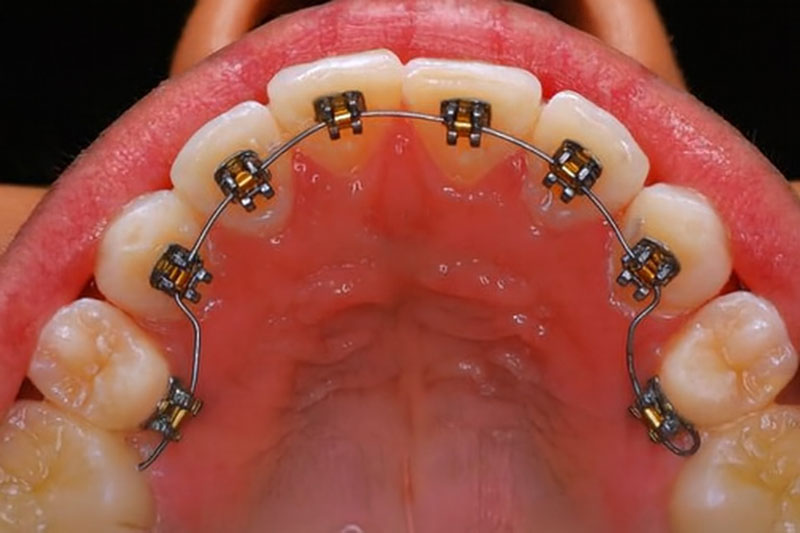
If you want straighter teeth but the idea of visible metal brackets puts you off, lingual braces could be exactly what you’re looking for. They work like traditional fixed braces but with one important difference: they’re fitted to the back of your teeth, making them virtually invisible from the front. At Parkhead Cross Orthodontics & Facial Aesthetics in Glasgow, we offer lingual braces as part of our range of discreet orthodontic options.
How Do Lingual Braces Work?
Lingual braces use the same principle as conventional fixed braces. Brackets are bonded to each tooth and connected by a wire, which applies gentle, consistent pressure to move teeth into the desired position over time. The key difference is that with lingual braces, the brackets and wire sit on the inner (tongue-facing) surface of your teeth rather than the outer surface.
This means that when you smile, speak or laugh, there’s nothing visible at the front of your teeth. For adults in particular, who may feel self-conscious about wearing visible braces, this can make a significant difference to how comfortable they feel throughout treatment.
Who Are Lingual Braces Suitable For?
Lingual braces can treat a wide range of orthodontic issues, including crowding, spacing, overbites, underbites and crossbites. They tend to work particularly well for adults who need comprehensive orthodontic treatment but want to keep their braces hidden, whether for professional reasons or personal preference.
They are a good option if:
- You want a highly discreet treatment that’s not visible from the front
- You play contact sports or a wind instrument (where removable aligners may not always be practical)
- You have a complex case that might not be ideal for clear aligners
- You want the reliability of fixed braces without the visible appearance
Our orthodontic team will assess your teeth at your consultation and advise whether lingual braces are the most suitable option for your specific needs.
Lingual Braces vs Fixed Braces
Conventional fixed braces are fitted to the front of the teeth. They’re highly effective, cost-efficient and suitable for patients of all ages. The main drawback for many adults is that they’re visible. Lingual braces solve this problem while delivering comparable results, though they do tend to cost a little more due to the custom fitting process involved.
Lingual Braces vs Clear Aligners
Clear aligners such as Invisalign and Spark aligners are another popular discreet option. Unlike lingual braces, they’re removable, which makes eating, brushing and flossing easier. However, because they can be taken out, they rely on patient compliance, and some complex cases may still be better suited to fixed treatment. Your orthodontist will talk through the pros and cons of each option based on your individual case.
What’s the Adjustment Period Like?
Most patients find there is a short adjustment period with lingual braces. Because the brackets sit close to the tongue, speech can feel slightly different at first, and there may be some initial discomfort. Most people adapt within a couple of weeks and find the minor adjustment period well worth it for the level of discretion lingual braces provide.
Orthodontic Treatment at Parkhead Cross
Whether you choose lingual braces, clear aligners or conventional fixed braces, you’ll receive the same high standard of care from our experienced team. Explore all our orthodontic treatments or book a consultation to discuss the best option for your smile. We also offer flexible 0% finance options to help spread the cost.
We’re located at 47/49 Tollcross Road, Parkhead, Glasgow, with free parking at the rear and excellent bus links nearby. Call us on 0141 739 0840 to get started.
Frequently Asked Questions
Yes. Lingual braces are just as effective as conventional fixed braces and can treat most of the same orthodontic issues. Your orthodontist will confirm whether they’re suitable for your specific case at your consultation.
There is usually a short adjustment period where speech can feel slightly different. Most patients adapt within one to two weeks as their tongue gets used to the new position of the brackets.
Lingual braces do typically cost more than conventional fixed braces due to the custom fitting process. We offer 0% finance to help make treatment more affordable.
Treatment time varies depending on the complexity of your case, but it’s broadly similar to conventional fixed braces, typically between 12 and 24 months.
Book a consultation at Parkhead Cross and our orthodontic team will assess your teeth and discuss all the options available to you. Call us on 0141 739 0840 or visit our contact page.